 Developers
Build and test your integration in the sandbox. It runs the same API and the same Wholesale Portal as production, but nothing in it reaches a carrier. The sandbox answers qualifications and orders itself, in the carriers’ own formats, and moves the orders along. Nothing you do there is billed.
| Production | Sandbox | |
|---|---|---|
| API | https://api.checknetworks.tools/v2 |
https://api.checknetworks.dev/v2 |
| Portal | your usual Wholesale Portal | https://portal.checknetworks.dev |
Getting a sandbox
An Owner or Admin sets one up. In the production portal, go to Company Settings, then Integrations, then API Keys and choose Create Sandbox. We set it up for your account and copy your portal users across. They keep their names, emails and roles, but not their passwords. To sign in, choose Open Sandbox on the same page. You are signed in to the sandbox as the same user.
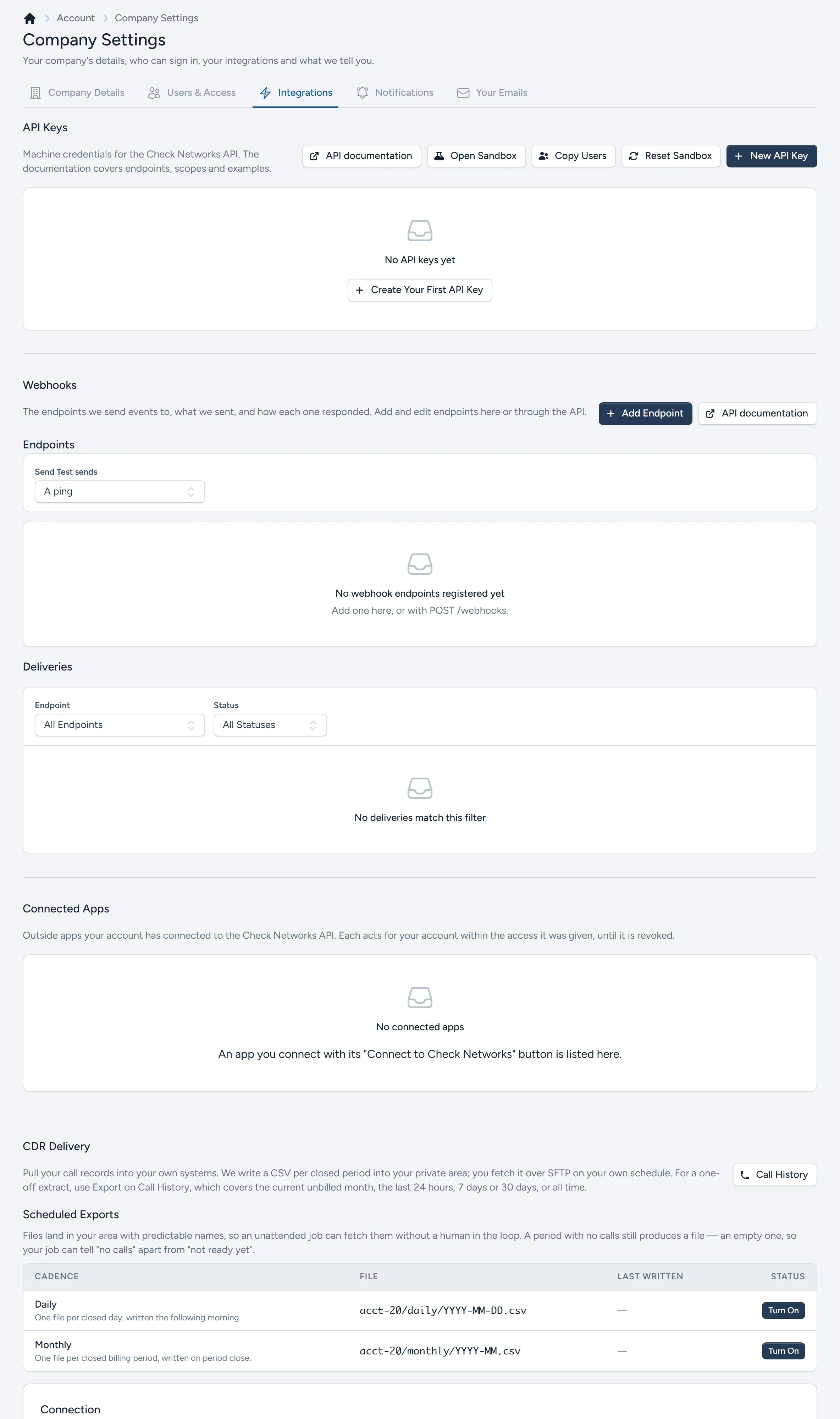
The link works once, and only for a minute. Open it again from the production portal each time.
Open Sandbox needs two-factor authentication. It works only if you signed in to the production portal with your two-factor code. That sign-in counts for the sandbox too, so the sandbox doesn’t ask for a code again. If you haven’t turned two-factor on, set it up under Profile. Then sign out and sign in again before you open the sandbox. A sign-in from before you turned it on doesn’t count.
If a user is added to production after the sandbox was set up, an Owner or Admin chooses Copy Users there. The new user can then sign in.
Your sandbox account is yours alone. Its API keys, services, orders and webhooks are separate from production and from every other customer’s sandbox. Create sandbox API keys in the sandbox portal, the same way as in production. The only difference is that the sandbox never asks for your password, because you don’t have one there. See API keys and scopes.
A production key doesn’t work in the sandbox, and a sandbox key doesn’t
work in production. Get sandbox tokens from the sandbox, at
https://api.checknetworks.dev/v2/oauth/token.
To tell the two apart, look at the secret. A sandbox secret starts
cn_test_ and a production one starts cn_live_. GET /ping also answers
environment: sandbox or environment: live.
You can connect an OAuth app to your sandbox account too, once Check Networks has given the app a sandbox copy. Its consent screen is on the sandbox portal, and it is listed under Connected Apps there.
Addresses
The sandbox has its own test addresses, and your account gets 50 of each kind. Qualify one of them and the answer comes back as it would from the carrier. Any other address answers as not found. Your test addresses cover these cases:
- NBN FTTP, ready to connect, and FTTP that needs a build first.
- NBN FTTP whose NTD is full. Another provider’s service is on every port.
A
POST /data/ordersconnect there waits onorder.ntdFulluntil you attach an appointment for a new NTD or name a port to take over. - NBN FTTN, FTTC and FTTB, ready to connect on a spare copper pair. FTTN
and FTTC also say
upliftAvailable. Use them to try a Fibre Uplift withinstall: "fibreUplift"onPOST /data/orders. - NBN HFC and fixed wireless, ready to connect.
- NBN not serviceable.
- Opticomm, with the address’s real service class.
- Up to 10 premises on both networks. Each is in your list twice: as a
ready NBN FTTP address with its LOC, and as an Opticomm address with its
OPC.
GET /addresses/searchreturns bothnbnLocIdandopticommOpcIdfor it.
There are no satellite addresses, because we don’t sell on NBN satellite.
Searching by address (GET /nbn/address/search) finds only your own test
addresses. A real street outside your list answers nothing.
A serviceable address lists the plans you can order there in
availablePlans. They are the same plans and prices as production. Every
sandbox NBN address reports the same POI, 0SND, which no real address
has.
The /nbn qualification, address and planning answers come in NBN’s own
shape. A bandwidth keeps its decimal (40.0).
Each ready NBN address already has another provider’s service on it,
either on port 1 of the NTD or on the second copper pair. The first pair
is spare.
To test a transfer, qualify the address with that service’s AVC and a
customerAuthorityDate. Your address list gives the AVC in existing_avc.
It is AVC followed by the LOC’s twelve digits. The port or pair comes
back with serviceIDMatch: true. Any other AVC answers NBN’s RJ002003.
The PRI in supportingProduct is NBN’s product id, not the AVC.
A ready FTTP address’s NTD can’t carry Home Hyperfast, so its planning
record says the upgrade needs a new NTD. Every FTTP address came to fibre
by a technology change. Its planning record also carries COATName,
technologyFlipDescriptor, changeoverEndDate and the old line’s
disconnectionDate.
GET /nbn/service_qualification/fibre_uplift answers only at an FTTN or
FTTC address, the two whose qualification says
alternativeTechnology: Fibre. Anywhere else the carrier refuses the location
as invalid input, and the API answers 422 with validation_failed.
An Opticomm address answers as Opticomm does for its service class. Your addresses include every class in the sandbox:
| Class | Opticomm answers | Use it to test |
|---|---|---|
| 1 | Rejected |
an address you cannot order |
| 2 | Serviceable - Shortfall, no OTD yet, a Standard Install and the new connection charge |
an order that needs an install appointment |
| 3 | Serviceable, an OTD with port D1 in use, Service Restoration or Additional Install, and Service Transfer |
a connect with no install, an Additional Install, a transfer |
| 5 | Serviceable, an OTD, the new developments charge |
an order with the developer charge |
GET /opticomm/singleSiteQualification/{opcId}?productAvailability=true
lists the bandwidth products at a serviceable address, by Opticomm’s own
product code. GET /opticomm/timeSlots answers an AM and a PM slot on each
day of the window you ask for, starting tomorrow.
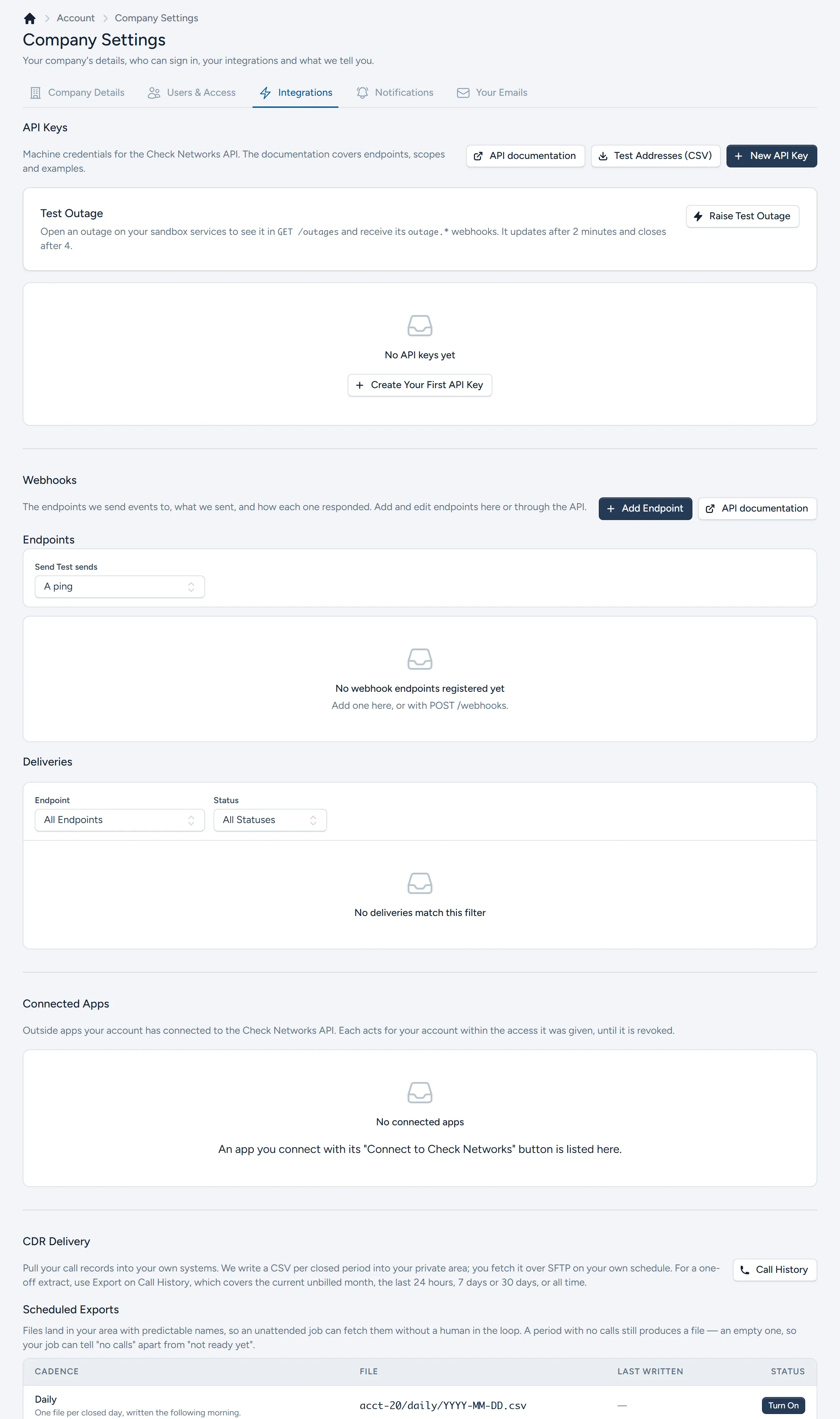
To download your test addresses, sign in to the sandbox portal and go to Company Settings, then Integrations, then API Keys. Choose Test Addresses (CSV).
Each row has the address, its LOC or Opticomm ID, the case it covers and
its current service class. existing_avc is the AVC of the service already
at a ready NBN address. same_premises names the other network’s address at
a premises on both. Once your order completes the build on an FTTP address,
the address shows its new class. Your Account Manager can add more
addresses.
Orders
The sandbox accepts an order the way the carrier does. The order then
moves through the carrier’s own steps, about a minute apart. An FTTP site
that needs a build takes a few minutes longer. You see each step as you
would in production. The order’s status changes and order.statusChanged
fires.
| Order | Status, step by step |
|---|---|
| Connect | accepted, in_progress, complete |
| Change or disconnect | accepted, complete |
| Cancel | cancelled |
When a connect completes, the sandbox builds the service and fires
service.provisioned. You can then read, change and disconnect the
service. Those orders move through their steps the same way.
Making the carrier refuse, fail, cancel or delay an order
To test what your integration does when a carrier doesn’t complete an
order, put one of these words in the connect’s customer reference. It has
to be a word of its own, such as ACME-1042-FAIL and not ACMEFAIL. The
result comes back as the carrier’s own callback. The order’s status changes
and the webhooks fire as they would in production.
| Word | What the carrier does | You see |
|---|---|---|
REJECT |
Refuses the order when it is placed. | The order is refused, with the carrier’s reason. |
FAIL |
Accepts it, then fails it with a reason. | accepted, then failed, with statusReason. |
CANCEL |
Accepts it, then cancels it. | accepted, then cancelled. |
DELAY |
Accepts it, then gives it a completion date a week away, then completes it a few minutes later. | accepted, in_progress, complete. The carrier order (GET /nbn/orders/product/{orderId} or GET /opticomm/productOrders/{orderId}) shows the new plannedCompletionDate. |
HOLD |
Opticomm only. Accepts it, then holds it waiting on you until you amend it with PATCH /opticomm/productOrders/{id}. |
accepted, then the order needs your action. Once you amend it, it carries on to complete. |
A change or a disconnect has no customer reference of its own. Choose its outcome in the sandbox portal instead. Open the service, choose Next Change or Disconnect and pick one of these:
| Choice | What the carrier does with the service’s next change or disconnect |
|---|---|
| Accept | Goes through as usual. This is what happens when you choose nothing. |
| Reject When Placed | Refuses it when it is placed, with the carrier’s reason. |
| Fail After Acceptance | Accepts it, then fails it with a reason. |
| Delay a Week, Then Complete | Accepts it, gives it a completion date a week away, then completes it a few minutes later. |
| Hold Until Amended | Opticomm only. Accepts it, then holds it waiting on you until you amend it with PATCH /opticomm/productOrders/{id}. |
| Take It but Time Out | Takes the order, but its answer to us never arrives. On NBN the order waits as delayed while our staff confirm the order with the carrier, then it goes on as usual. On Opticomm we find the order again by our reference and it goes on. |
| Never Answer | Never answers and doesn’t take the order. On NBN the order waits as delayed for our staff. On Opticomm we send it again. |
The choice applies only to the next change or disconnect on that service, whichever comes first. After that order, the service goes back to Accept. Words in the connect’s reference never carry over to a later order.
A failed or cancelled carrier order has the carrier’s reason in its
reasonCode. No separate event fires for a delay. In production a
carrier’s new date reaches you only on the carrier order, and the sandbox
does the same.
To test an Opticomm Service Transfer, use a class 3 address. It lists
another provider’s product under supportingProduct. Order it with
transferType Service Transfer and a customerAuthorityDate. The date
can be no later than today and no more than 45 days ago.
A fixed IP address on a sandbox service comes from 198.51.100.0/24. That
range is set aside for documentation, so the address is never routable.
Services
A sandbox service answers the same reads and actions as a production one. You can read its details and session, run line tests and service health checks, and manage appointments. A test or health check result arrives a moment later, as it does from the carrier. For appointments you can read available times, book, move and cancel.
Test outages
The sandbox network has no outages of its own. To see one, open the sandbox portal’s API Keys page, choose Raise Test Outage and pick one or more of your live services. A moment later an outage opens on those services’ postcodes. Your other sandbox services in the same postcodes are in it too.
It behaves as a full outage. It is in GET /outages and
GET /outages/{reference} with your affected services, and
outage.opened fires. Two minutes later it gets a new estimated
restoration time, and outage.updated fires. Two minutes after that it
closes, and outage.closed fires. It reaches only your account. You can
run one at a time.
Every line test passes and every health report is healthy, unless the
service’s customer reference has the word FAILTEST. A service’s customer
reference is its connect’s. With FAILTEST, every test on the service
fails with the carrier’s own failure fields. On NBN that is a result of
Failed with what was measured. On Opticomm it is Offline with the note
Failed. Its health reports come back degraded, as Amber. Use this to
build the path from a failed test to a fault ticket.
Every export from POST /exports is written and becomes ready, unless one
of its filters has FAIL as a word of its own. An example is
"filters": {"q": "FAIL"} on a cdrs or sms export. That export fails
the way a production export can. GET /exports/{exportId} shows state
failed with its failureReason, and export.failed fires.
Appointments
When an order names an appointment you reserved, the carrier books it a
moment after the order is placed, and appointment.booked fires. To see a
carrier change a booked visit, put one of these words in the appointment’s
notes or in the order’s customer reference. The notes are NBN
siteAccessNotes or siteAccessInstructions, or Opticomm siteAccess.
| Word | What the carrier does |
|---|---|
RESCHEDULE |
Moves the visit a day later, a moment after booking it. On NBN the appointment’s new time and appointment.rescheduled follow. Opticomm reports the move on the order, as AppointmentRescheduled, which asks you to look at the appointment. |
APPTCANCEL |
Cancels the visit, a moment after booking it. The appointment is Cancelled and appointment.cancelled fires. |
Testing your retries
To test how your integration handles a busy or failing API, send the
CN-Sandbox-Simulate header on any sandbox call with one of these values:
| Value | Answer |
|---|---|
429 |
429 - Too Many Requests, code rate_limited, with Retry-After: 60 |
502 |
502 - Bad Gateway, code carrier_unavailable |
503 |
503 - Service Unavailable, code service_unavailable, with Retry-After: 60 |
The answer has the same error body as in production. The call itself
doesn’t run, so nothing is read, written or ordered. Any other value
answers 400. Production ignores the header, so you can leave it in code
that runs against both.
Webhook events in the sandbox
Most events fire in the sandbox as they do in production. Events that come
from calls, our live network or our staff don’t. To get one of those, call
POST /webhooks/{webhookId}/test with the event’s eventType. We deliver
a made-up event of that type to the endpoint.
| Event | Fires in the sandbox | How to make it fire, or why it does not |
|---|---|---|
ticket.created |
Yes | Open a ticket. |
ticket.replied |
Yes | Add a message to one of your tickets. |
ticket.statusChanged |
Yes | Resolve or reopen a ticket with PATCH /tickets/{ticketRef}. |
ticket.csatSubmitted |
Yes | Rate a resolved ticket with POST /tickets/{ticketRef}/csat. |
ticket.informationRequired |
No | Our staff ask you for more information on a ticket. |
voice.call.completed |
No | The sandbox carries no calls. |
voice.voicemail.received |
No | The sandbox carries no calls. |
voice.recording.ready |
No | The sandbox carries no calls. |
trunk.down |
No | A trunk’s state comes from our live network, which the sandbox never reaches. |
trunk.up |
No | A trunk’s state comes from our live network, which the sandbox never reaches. |
callerId.statusChanged |
No | Our staff decide a caller ID request by hand. |
voice.hold.placed |
No | A hold follows call spend and calling patterns, and the sandbox carries no calls. |
voice.hold.released |
No | A hold follows call spend and calling patterns, and the sandbox carries no calls. |
number.assigned |
Yes | Assign one of your sandbox numbers to a trunk. |
number.unassigned |
Yes | Take a number off its trunk. |
number.released |
Yes | Release a number. It fires when the release runs. |
number.suspended |
No | Our staff suspend a number. |
number.reactivated |
No | Our staff reactivate a number. |
ipnd.recordRejected |
No | The sandbox never sends records to the IPND. |
trunk.planChangeScheduled |
Yes | Move a trunk to a smaller plan or fewer channels. The change is booked for the next billing date. |
trunk.planChangeCancelled |
Yes | Cancel a booked trunk plan change. |
trunk.planChanged |
Yes | Move a trunk to a larger plan, which takes effect at once. |
bookedChange.applied |
Yes | A booked trunk plan change takes effect on the 1st of the month. |
bookedChange.cancelled |
Yes | Cancel a booked trunk plan change. |
bookedChange.failed |
Yes | Book a data disconnect for a later day, and choose Reject When Placed for the service in the sandbox portal. On its day the carrier refuses it. |
bookedChange.rescheduled |
No | Only Check Networks staff move a booked disconnect to another day, so the sandbox never does. |
invoice.issued |
Yes | Your monthly invoice is raised as in production. |
invoice.paid |
Yes | Simulate a payment that succeeds and covers the invoice. |
invoice.voided |
No | Our staff void an invoice. |
payment.received |
Yes | Simulate a payment that succeeds. |
payment.succeeded |
Yes | Simulate a payment that succeeds. |
payment.failed |
Yes | Simulate a declined payment. |
payment.reversed |
Yes | Simulate a reversal of the invoice’s last simulated payment. |
creditNote.issued |
No | Our staff issue a credit note. |
dispute.raised |
Yes | Dispute a charge on one of your invoices. |
dispute.decided |
No | Our staff decide a dispute. |
invoice.overdue |
No | Nothing is collected in the sandbox, so no invoice goes overdue. |
paymentMethod.expiring |
No | The sandbox holds no payment methods. |
credit.thresholdReached |
No | Credit is used by calls, and the sandbox carries no calls. |
credit.callsBlocked |
No | Credit is used by calls, and the sandbox carries no calls. |
credit.callsRestored |
No | Credit is used by calls, and the sandbox carries no calls. |
priceRise.noticed |
No | Our staff give notice of a price rise. |
usage.thresholdReached |
No | Usage comes from calls, and the sandbox carries no calls. |
usageAlert.triggered |
No | Usage comes from calls, and the sandbox carries no calls. |
data.realm.approved |
No | Our staff decide a realm request. |
data.realm.rejected |
No | Our staff decide a realm request. |
data.radius.sessionRetrieved |
No | A session is read from our live network, which the sandbox never reaches. |
order.statusChanged |
Yes | Every order step. Place, change, disconnect or cancel an order. FAIL, CANCEL and DELAY in its reference show the carrier failing, cancelling or delaying it. |
order.delayed |
Yes | Place a delayed order, or move its submit time. |
order.appointmentRequired |
Yes | Place a connect with POST /data/orders, without an appointment, at an address that needs one. That is an FTTP build or an Opticomm class 2. |
order.ntdFull |
Yes | Place a connect with POST /data/orders at one of your full-NTD test addresses, without naming a port. |
port.actionRequired |
No | The sandbox never ports a number from a real carrier. |
delegation.used |
No | The link and its code go by email, and the sandbox sends no email. |
service.provisioned |
Yes | A connect completes. |
service.suspended |
No | Our staff suspend a service. |
service.resumed |
No | Our staff resume a service. |
service.disconnected |
Yes | A disconnect completes. |
service.ceaseScheduled |
No | The sandbox carriers never schedule a cease of their own. |
diagnostic.completed |
Yes | Run a line test. FAILTEST in the service’s reference makes it fail. |
serviceHealth.reportReady |
Yes | Ask for a service health report. FAILTEST in the service’s reference makes it degraded. |
ontUpgrade.completed |
No | The sandbox never raises an ONT upgrade with the carrier. |
appointment.booked |
Yes | Place an order with an appointment. The carrier books it. |
appointment.rescheduled |
Yes | RESCHEDULE in the appointment’s notes or the order’s reference moves the visit a day later, on NBN and Opticomm alike. |
appointment.cancelled |
Yes | APPTCANCEL in the appointment’s notes or the order’s reference, or cancel a booked appointment yourself. |
outage.opened |
Yes | Raise a test outage on the sandbox portal’s API Keys page. |
outage.updated |
Yes | A test outage gets a new restoration time two minutes after it opens. |
outage.closed |
Yes | A test outage closes two minutes after its update. |
degradation.opened |
No | The sandbox network has no degradation. |
degradation.updated |
No | The sandbox network has no degradation. |
degradation.closed |
No | The sandbox network has no degradation. |
quote.completed |
Yes | Ask for an Enterprise Ethernet quote with POST /nbn/quotes. |
quote.actionRequired |
Yes | Ask for a quote with INFO in its rspReference. It is held waiting on more information. |
quote.closed |
Yes | Ask for a quote with NOQUOTE in its rspReference. The carrier can’t price it, and says why. |
endUser.spendThreshold |
No | Spend comes mostly from calls, and the sandbox carries no calls. |
endUser.creditNote.issued |
Yes | Issue a credit note on one of your end users’ bills. |
endUser.dispute.raised |
Yes | An end user disputes one of your bills. |
endUser.dispute.decided |
Yes | Decide an end user’s dispute. |
endUser.created |
Yes | Create an end user. |
endUser.updated |
Yes | Change an end user. |
endUser.suspended |
Yes | Suspend an end user. |
endUser.reactivated |
Yes | Reactivate an end user. |
sms.received |
No | SMS travels on our live network, which the sandbox never reaches. |
sms.delivered |
Yes | Send an SMS with POST /sms to 61491570006. It is delivered a few seconds later. |
sms.failed |
Yes | Send an SMS with POST /sms to 61491570156. It fails as undeliverable a few seconds later. |
fax.received |
No | Fax travels on our live network, which the sandbox never reaches. |
fax.sent |
No | Fax travels on our live network, which the sandbox never reaches. |
fax.failed |
No | Fax travels on our live network, which the sandbox never reaches. |
account.suspended |
No | Our staff suspend an account. |
account.reinstated |
No | Our staff reinstate an account. |
webhook.endpointDisabled |
Yes | One of your endpoints fails often enough to be switched off. Your other endpoints get the event. |
export.ready |
Yes | Start an export with POST /exports. |
export.failed |
Yes | Start an export with the word FAIL in a filter, such as q. |
transit.blackhole.placed |
No | A blackhole is placed on our live border routers, which the sandbox never reaches. |
transit.blackhole.released |
No | A blackhole is placed on our live border routers, which the sandbox never reaches. |
transit.blackhole.expired |
No | A blackhole is placed on our live border routers, which the sandbox never reaches. |
Some events are offered only while we offer their product. The event types page lists the ones you can subscribe to now.
Enterprise Ethernet quotes
The sandbox acknowledges POST /nbn/quotes for any LOC at once and prices
the quote about a minute later. The carrier takes hours or days to do the
same. The quote.completed webhook fires, and the quote is then in
GET /nbn/quotes and GET /nbn/quotes/{quoteId}. Every priced sandbox
quote has the same fibre build contribution of AUD 4,500.00, valid for 85
days.
To test the other outcomes, put one of these words in the quote’s
rspReference:
| Word | What the carrier does |
|---|---|
NOQUOTE |
Can’t price it. The quote is Rejected with the carrier’s reason in eventNote, and quote.closed fires. The location can be quoted again. |
INFO |
Holds it waiting on more information. The quote stays InProgress with subStatus Pending and the carrier’s question in eventNote, and quote.actionRequired fires. |
Numbers
Numbers you buy in the sandbox portal come only from the ranges set aside
for fiction. These are 02 5550 xxxx, 03 5550 xxxx, 07 5550 xxxx and
08 5550 xxxx. None of them is a real number.
Call records
The sandbox carries no calls. Instead, a moment after you make a trunk there, it gets three days of call records. They include local, mobile and international calls, and calls that were busy or not answered. Every number called is one set aside for fiction. Each call is priced with your trunk’s rates, as a real call is.
Read the records with GET /voice/cdrs. They are in the same shape as
production records. No voice.call.completed fires for them. A sandbox
reset removes your trunks, and their call records go with them.
SMS
POST /sms and POST /sms/bulk send in the sandbox, but only to the
mobile numbers ACMA sets aside for creative works and documentation. None
of them is a real service, so nothing you send reaches a person. A send
answers 202 with a messageId, as in production. Poll the message with
GET /sms/messages/{messageId}. What happens to it depends on the number:
| Number | What happens |
|---|---|
61491570006 |
pending, then delivered a few seconds later. sms.delivered fires. |
61491570156 |
pending, then failed as undeliverable a few seconds later. sms.failed fires. |
61491570157 |
pending, then delivered after about a minute, to test polling. sms.delivered fires. |
61491570158 |
Stays pending. No delivery receipt ever arrives. |
61491570159 |
Refused when you send it, with 502 and carrier_unavailable, as when the SMS service won’t take a message. |
The other 25 numbers behave as 61491570006 does, so a bulk send has
enough numbers that are delivered: 61491570110, 61491570313,
61491570737, 61491571266, 61491571491, 61491571804, 61491572549,
61491572665, 61491572983, 61491573770, 61491573087, 61491574118,
61491574632, 61491575254, 61491575789, 61491576398, 61491576801,
61491577426, 61491577644, 61491578957, 61491578148, 61491578888,
61491579212, 61491579760 and 61491579455.
Any other number answers 422 with validation_failed, and the reason
names the documentation numbers. POST /sms/bulk answers each number as
POST /sms would. 61491570159 and any number outside the list come back
rejected, and the rest are sent.
Send from 61491570110. Your sandbox account starts with that one
sender approved, and a reset puts it back.
The sender rules are the same as in production. A sender that isn’t
approved for your sandbox account answers 403 with sender_not_approved.
Any other sender you request stays pending. Each sandbox message is rated at $0.10 a segment. The sandbox
takes no real money. No texts arrive in the sandbox, so sms.received
never fires there.
Payments
To test your payment handling, open an issued invoice in the sandbox portal and choose Simulate Payment. Then pick one of these:
| Choice | What happens | Events |
|---|---|---|
| Payment Succeeds | A payment for the balance is recorded and the invoice is paid. | payment.succeeded, payment.received, invoice.paid |
| Payment Is Declined | The card is declined. The invoice stays open. | payment.failed |
| Last Payment Is Reversed | The invoice’s last simulated payment is dishonoured, and the invoice is open again. This choice appears once a simulated payment has succeeded. | payment.reversed |
The payment shows in GET /account/payments as a real one does, with the
gateway sandbox.
What the sandbox does not do
| Missing | What happens instead |
|---|---|
| Nothing the sandbox does sends an email. Use webhooks to follow your orders. | |
| Live network | A trunk’s registration state, live call sessions, resending a mobile port’s verification code and sending a fax all act on our live network. In the sandbox they answer 501 with the reason. Subscribing an address to outage notices answers the same, because it sends a real person a confirmation. The sandbox carries no calls, so the live call list is empty. |
| Xero | The /integrations/xero routes and an end user’s Xero contact link call your own Xero organisation. In the sandbox they answer 501 with the reason. |
| Real payments | Invoices are raised as in production, but nothing is ever collected. Use Simulate Payment instead, as described above. |
Resetting the sandbox
A reset gives your next test run a clean start. It wipes your sandbox account’s orders, services, bills and callbacks, and puts its test addresses back to how they started. Its users, API keys and addresses are kept.
An Owner or Admin resets the sandbox with Reset Sandbox on API Keys in
the production portal. Your tests can reset it with POST /sandbox/reset
on the sandbox API. That call needs account:update.
You can reset a sandbox 3 times in any 24 hours, counting the portal and
the API together. After that, the portal says when the next reset is
allowed. The API answers 429 with Retry-After, which is the number of
seconds until then.